

The Mallard is often the first waterbird people learn to recognise. You meet it along a pond, on a slow river, in an urban park—sometimes even on a small ornamental lake. It has that quiet familiarity of species that live close to us and, without fuss, open the door to the world of wetlands. Behind its apparent “commonness”, the Mallard is an excellent guide: it tells a story of adaptation, seasons, life along the banks… and the small actions that can make a real difference for freshwater wildlife.
Classification
-
Order: Anseriformes
-
Family: Anatidae
-
Genus: Anas
-
Species: Anas platyrhynchos
The Mallard belongs to the large family of ducks, geese and swans. It is often described as a Holarctic species, found across a wide part of the Northern Hemisphere—proof of its remarkable ability to adapt. Wherever there is water, even in highly managed landscapes, it often finds a place.
Identification
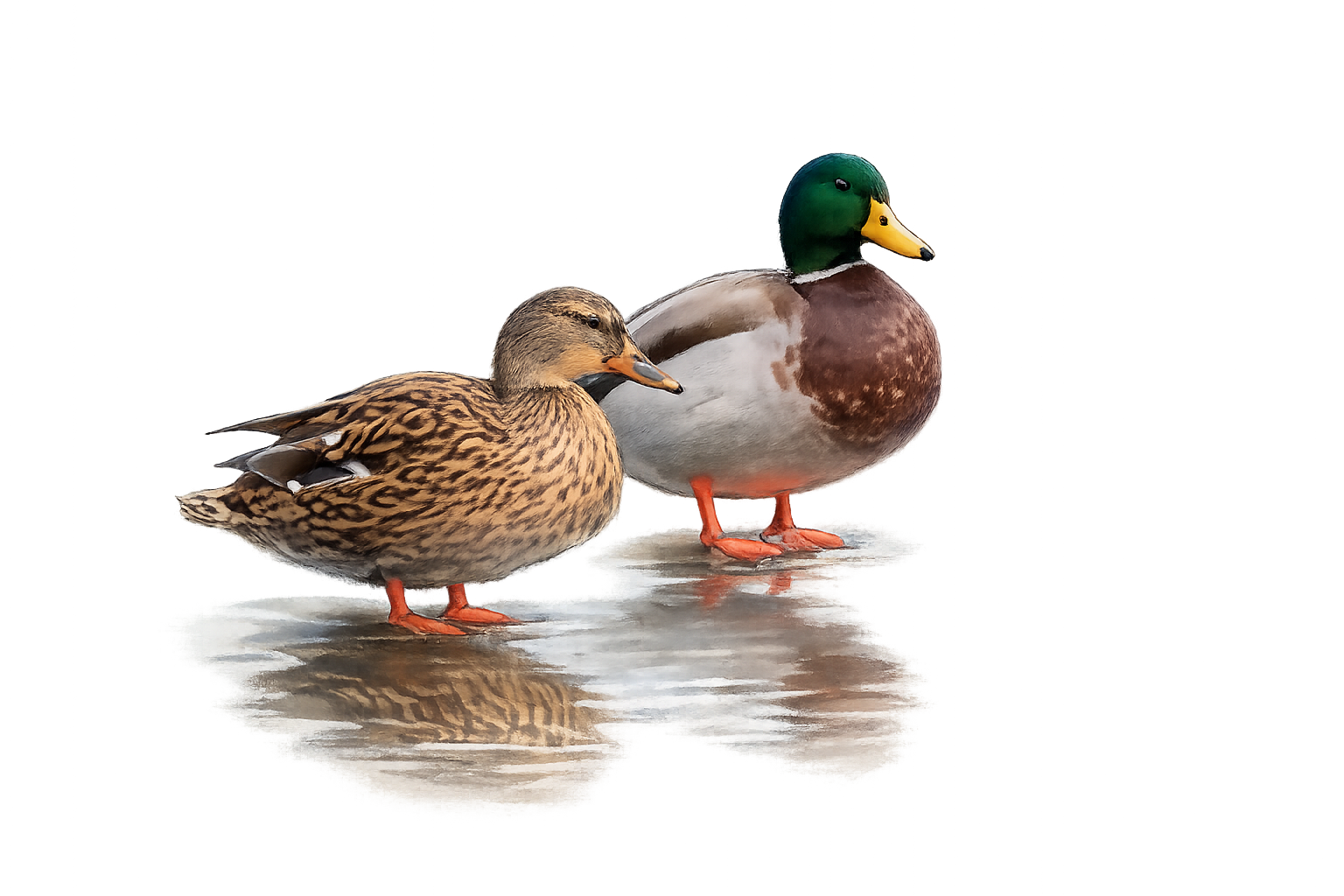
Sometimes, a single glance is enough. The male in breeding plumage wears a glossy green head that catches the light, a more or less distinct white neck ring, a chestnut-brown breast, and a pale grey body. The bright yellow bill completes the signature.
The female plays a different tune: mottled brown, more discreet, built to blend into bank vegetation. Her bill is often orange, with a darker centre.
But the detail shared by both sexes—and especially useful when everything happens quickly—is the blue wing speculum edged in white. At rest it can be glimpsed; in flight it becomes a clear, reliable marker.
Calls and vocalisations
By the water, you often hear it before you look up. The Mallard is not shy: the female gives the well-known loud, harsh quack, repeated in a short series like an insistent phrase. The male seems to speak more softly: a lower, raspier sound, sometimes described as a muted whistle or a nasal rattle. In spring, their exchanges become more frequent and varied, as if the banks had turned into a conversation stage.
Habitat
What stands out about the Mallard is its flexibility. It settles almost anywhere: ponds, rivers, lakes, marshes, canals, urban parks, even artificial basins. Still, it often favours quiet areas with bankside vegetation (reeds, tall grasses, shrubs) anything that offers cover, resting places and nesting opportunities. A “living” bank matters more to it than perfectly open water.
Behaviour
You rarely see it alone for long. Outside the breeding season, it readily gathers in small groups, sometimes larger in winter. The Mallard is also an opportunist: in parks it approaches people easily, especially where feeding is common—sometimes too common. That familiarity can be misleading: it often goes with overcrowding, poorer water quality and altered behaviour.
And then there is its classic, almost comical gesture: dabbling. The duck tips forward, head under water, tail up like a small flag, probing the water and mud for plants and invertebrates. It is an easy behaviour to watch, and a great way to learn to observe not just where a bird is, but how it feeds.
Flight
When it decides to leave, the Mallard does not hesitate. It takes off quickly, sometimes almost vertically, then settles into a strong, direct flight with rapid wingbeats. That is often when the blue speculum edged in white stands out most clearly—an identification cue visible even at distance, when body colours blur with speed and light.
Diet
The Mallard is omnivorous. It feeds on aquatic plants, seeds, and also small molluscs, insects and crustaceans. In urban areas it is often tempted by bread—because it is abundant and easy. But this “treat” is deceptive: it can unbalance the diet, encourage local overconcentration and degrade water quality.
If you want to act responsibly, the best approach is often not to feed at all—or to do so only rarely and thoughtfully, with food closer to its natural diet.
Breeding and nesting
The breeding season can start early, from late winter. Courtship is subtle but real: the male shows off through posture as much as colour, repeating displays and vocal cues, then the female chooses.
The nest is usually hidden on the ground in dense vegetation near water—sometimes surprisingly far from the banks. She typically lays 8 to 12 eggs and incubates them alone for about 28 days. The ducklings are precocial: they leave the nest very soon after hatching. It is a striking moment—life shifts immediately towards the water, and the female becomes guide, protector and moving shield.
Distribution
The Mallard occurs across Europe, Asia, North America and North Africa. Depending on the region it may be resident or a partial migrant, moving with winter conditions. Here again, its strength is plasticity: it can cope with climates, habitats and even very human-shaped landscapes.
Threats and protection
Because it is common, we sometimes forget that the Mallard depends—like all waterbirds—on the quality of aquatic habitats. It is affected by hunting pressure, water pollution, the loss of wetlands and disturbance during nesting. In cities, inappropriate feeding adds a less visible but very real pressure.
It is managed under regulations (hunting seasons and limits where applicable). Ecologically, it plays a role in freshwater systems: through movement and feeding it can contribute to seed dispersal and it is part of wetland food webs.
To go further
Watching a Mallard is often a first step into birdwatching—not because it is “simple”, but because it is accessible: you can see it, hear it, and it quickly demonstrates what a shoreline, a behaviour and a season look like. Learn to truly watch a Mallard, and the rest opens up: teal, pochards, grebes, herons… and the entire living world of freshwater wetlands.