

A tiny ritual, a huge effect.
In a school day, there are those moments when you can feel attention fraying. The hubbub of recess still clings to sleeves, minds are elsewhere, and yet the lesson has to “begin.” You could raise your voice, speed up, tighten the schedule. Or you could do the opposite: open a small window onto the real world.
One question is enough.
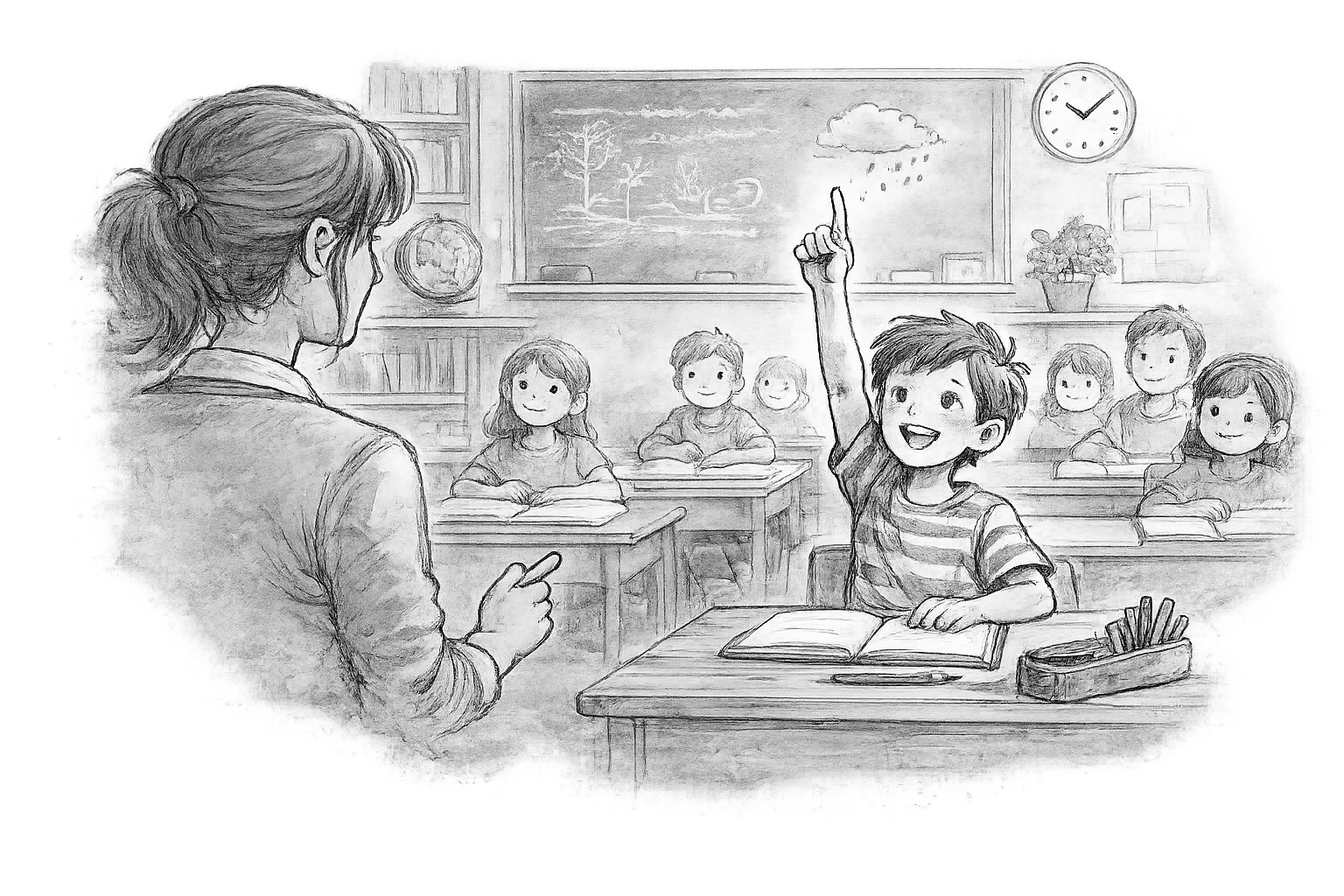
A short question, asked simply, as you might set a stone on the table: “What did you notice outside today that you’d never noticed before?” At first there’s often silence. Not a silence of resistance, more a silence of searching. Students rummage through their recent memory—images from the playground, the morning walk, the sky, a leaf, a sound. And then someone ventures: “I saw a bird that…,” “There was frost…,” “The trees are bare….”
At that moment, something clicks into place. The outside world returns to the classroom. And with it, a precious reflex: observe before asserting.
That’s the whole spirit of “flash questions”: a 3-to-5-minute ritual, with no equipment, that turns an ordinary day into an investigation. The first goal isn’t to find the “right” answer. The first goal is to get thinking moving: an observation, a hypothesis, a justification.
The ritual: simple, steady, reassuring
The framework is deliberately minimal. It comes down to four moves.
First, the question, stated clearly. One only. Not a barrage.
Next, a few rapid-fire answers. Three, four, five voices. No debate yet. You collect.
Then comes the sentence that changes everything: “What makes you think that?”
Here, you gently shift from “I think” to “because.” Some students lean on a concrete detail (“I saw…,” “I heard…”). Others offer an explanation (“maybe…,” “it could be…”). Even when the explanation is approximate, you have something valuable: a line of reasoning you can help grow.
Finally, a very short, almost neutral synthesis: “We have two ideas today…,” “What we’re taking away is…,” “We’re not sure, but we have a lead….”
And the class can move on—more grounded, more attentive.
Over the weeks, this micro-practice builds a rare skill: students learn they have the right not to know, but also the duty to justify what they put forward.
Why it works (even when time is short)
Because nature is immediate. It doesn’t require a screen, a worksheet, an app. It’s there: the sky, the wind, a blade of grass between paving stones, a blackbird on a branch, an insect on a windowsill.
And because these questions activate three powerful levers:
-
wonder (something is always happening outside, even in winter);
-
critical thinking (learning to distinguish observation from interpretation);
-
language (describing precisely is already a scientific act).
You can use them in science, of course, but also in language arts (describe, narrate), civics (respectful debate), geography (landscape), art (observational sketching). It’s a small format, but a major crossroads.
The 20 flash questions
I’m offering them here as a “toolbox”: you can pick one at random, follow one per season, or build a progression.
Observe and describe
-
What did you notice outside today that you’d never seen before?
-
If you had to describe the sky in three words, which would you choose? Why?
-
What was the last natural sound you heard: wind, bird, water, leaves…?
-
In your opinion, what is the most “alive” detail in the playground (or on the street)?
Habitats and needs of living things
-
What does a bird absolutely need in order to live here?
-
Why do some animals live near humans, while others don’t?
-
What spot in the playground could be a refuge? What makes it a refuge?
-
A hedge—would you say it’s more like a wall, a road, or a home for living things? Explain.
Seasons and change
-
What signs tell you the season is changing (without looking at the calendar)?
-
Why do leaves fall? Give two possible explanations.
-
What, in nature, is still “working” in winter?
-
If tomorrow it were 5°C warmer all year round, what would change around us?
Relationships between species
-
Who eats whom around here, near the school? Make a mini food chain.
-
Why don’t all birds eat the same thing?
-
Is nature mostly competition, or mostly cooperation? Give an example.
-
What is a predator for? Is it “useful”?
City, humans, impacts
-
What helps living things in the city: parks, gardens, wastelands…? Why?
-
Light at night: a good idea, a bad idea, or both? For whom?
-
Should we feed birds? When yes, when no?
-
A piece of litter on the ground—what does it become after a year? And after ten years?
Variations that change everything (without changing the question)
You can keep exactly the same question and vary the expected type of answer.
-
“Example” answer: “Give a concrete example.”
-
“Clue” answer: “What did you see/hear that makes you say that?”
-
“Hypothesis” answer: “What explanation do you propose?”
-
“Verification” answer: “How could we check?”
It’s a discreet differentiation tool: everyone participates, but not at the same level.
Two golden rules for a calm debate
-
You’re allowed to be wrong, but you must learn to justify.
-
We discuss ideas, never people.
With these two rules, the flash question becomes a safe space: you search together, adjust, improve.
A different end to the day
What’s striking is the cumulative effect. The first week, answers are brief. The second, they get longer. A month later, some students begin to say spontaneously: “I’m not sure, but I think…,” or “We could check by looking….”
That’s when the ritual reveals its true nature: it’s not just a “nature discussion.” It’s a school of attention. A way of learning to inhabit the world with more awareness—and therefore with more accuracy.
And all of that, sometimes, in three minutes. One question. One silence. Then the living world returns.